The abolition of Britain’s slave trade in 1807 was the result of a decades-long struggle. But why did it succeed when it did? The answer involves economics, Quaker faith, an extraordinary campaign — and the resistance of enslaved people themselves.
On 25 March 1807, the Slave Trade Act received Royal Assent, making it illegal for British subjects to participate in the transatlantic slave trade. The vote in the House of Commons had been 283 to 16 — a landslide, after two decades in which abolition had seemed politically impossible.
How did this happen? The question is not simple, and historians have argued about it for more than a century. The answer involves moral conviction, religious dissent, economic calculation, political timing, and — above all — the agency of enslaved people themselves, whose resistance made the trade increasingly costly and whose voices, when they could be heard, made its continuation increasingly difficult to defend.
The Economic Argument: Eric Williams and His Critics
The most influential — and most contested — account of abolition is economic. In 1944, the Trinidadian historian and later Prime Minister of Trinidad and Tobago Eric Williams published *Capitalism and Slavery*, a landmark work that argued abolition was possible only because the slave trade had become less economically vital to Britain.
Williams’s argument, developed from his doctoral research at Oxford, proceeded in two related steps. First, he argued that the profits of the slave trade and slavery had been a primary source of capital for Britain’s Industrial Revolution — that the wealth generated by Caribbean plantations had financed the mills, mines and infrastructure of industrial England. Second, he argued that by the late eighteenth century, the Caribbean slave economy was in decline, making abolition of the trade acceptable to the economic interests that had previously depended on it.
Williams was writing against a tradition of historiography that presented abolition as a triumph of British moral conscience. His intervention was genuinely radical: he insisted that interests, not idealism, drove historical change. His argument has been modified and partly challenged by subsequent scholarship — historians like Seymour Drescher, in his 1977 study *Econocide*, have shown that the British slave trade was actually at or near its commercial peak when it was abolished, making a purely economic explanation unsatisfactory. But Williams’s core insight — that moral arguments alone do not change systems of great economic power, and that the material interests of the powerful must be engaged — remains influential.
The Quakers: A Different Kind of Commerce
If economic interest alone cannot explain abolition, where do we look? A significant part of the answer lies in religion — specifically, in the long tradition of Quaker opposition to slavery.
The Religious Society of Friends — Quakers — had been debating the compatibility of slavery with Christian principles since the seventeenth century. In 1688, a group of German Quakers in Germantown, Pennsylvania, drafted what is now recognised as the first formal anti-slavery protest in American history. By the mid-eighteenth century, American Quaker leaders like John Woolman and Anthony Benezet had argued systematically that slaveholding was incompatible with Quaker principles of equality before God.
These arguments crossed the Atlantic. By the 1780s, British Quakers had become the most organised opposition to the slave trade in England. The Meeting for Sufferings — the Quakers’ national administrative body — began petitioning Parliament against the trade in 1783. The Quaker network provided the organisational infrastructure for the broader abolitionist campaign: their meeting houses served as meeting places, their publishing connections spread abolitionist literature, and their commercial networks gave them access to the middle-class public that the campaign needed to reach.
The Society for Effecting the Abolition of the Slave Trade
In 1787, the formal abolitionist campaign took institutional shape. The Society for Effecting the Abolition of the Slave Trade was founded in London on 22 May 1787 at a printing shop in the City. Its twelve founding members included nine Quakers and three Anglicans — among them Granville Sharp, who had already won several important legal cases establishing limits on the use of English law to enforce slavery, and Thomas Clarkson.
Thomas Clarkson was the campaign’s investigative engine. A young Cambridge graduate who had won a prize essay competition on the topic “Is it lawful to enslave the unconsenting?”, he had been converted to abolitionism in the course of writing his essay. He devoted the next two decades of his life to the cause, travelling thousands of miles on horseback to gather evidence, interview sailors who had served on slave ships, and collect the instruments of torture used in the trade. His chest of evidence — shackles, thumbscrews, branding irons, models of slave ship holds — became a standard feature of abolitionist public meetings.
William Wilberforce was recruited to lead the parliamentary campaign. He was well-chosen: a friend of Prime Minister William Pitt the Younger, a gifted orator, an Evangelical Anglican of impeccable social standing. He introduced the abolition bill to Parliament for the first time in May 1789. It failed. He introduced it again, and again it failed. He was defeated, or the bill was delayed, eight times between 1789 and 1806. The slave trade lobby — West India merchants, plantation owners with seats in Parliament, shipping interests in Liverpool and Bristol — was powerful, well-organised and wealthy. They argued that abolition would destroy the British economy, undermine national security, and in any case would be pointless because France, Portugal and the United States would simply fill the space vacated by Britain.
The Campaign: Sugar, Ships and the Wedgwood Cameo
The abolitionist campaign deployed what we would now recognise as modern political activism. Its most visible innovations were:
**The sugar boycott**: Beginning in 1791, abolitionist pamphlets encouraged the public to stop buying slave-produced sugar. An estimated 300,000 people in Britain boycotted sugar at the movement’s peak — a remarkable demonstration of the idea that ordinary consumers had responsibility for the chains of supply and production that connected their dining tables to the plantations. The boycott was particularly associated with women, who often managed household purchasing. It was the forerunner of every modern ethical consumption campaign.
**The Brookes image**: In 1788, the Plymouth Committee for the Abolition of the Slave Trade produced a diagram of the slave ship *Brookes*, showing in plan view how 482 enslaved people were packed into the ship’s hold. The image — formally titled “Plan and Sections of a Slave Ship” — was reproduced in tens of thousands of copies and displayed in homes, meeting houses and public buildings across Britain. It made abstract knowledge visceral and undeniable. It is one of the most effective pieces of political graphic design in history.
**The Wedgwood medallion**: Josiah Wedgwood, the Staffordshire pottery manufacturer and a member of the Abolitionist Committee, produced a cameo in 1787 showing an enslaved man on his knees in chains, with the legend “Am I not a man and a brother?” The image was reproduced on snuffboxes, hairpins, cufflinks, pottery — fashionable objects that carried an abolitionist message into domestic life. It was the nineteenth-century equivalent of a campaign badge, and it made abolitionism a visible part of polite society.
**The mass petition**: The 1792 abolition petition campaign collected an unprecedented 519,000 signatures — the largest petition in British history to that date. It was a demonstration not only of public feeling but of the organisational capacity of the abolitionist network, which could mobilise communities across the country.
The Black Abolitionists: The Voices That Mattered Most
The standard narrative of British abolition has traditionally foregrounded white heroes — Wilberforce, Clarkson, Sharp. Recent scholarship has increasingly insisted on the centrality of Black abolitionists, without whose voices and efforts the campaign would have been immeasurably weaker.
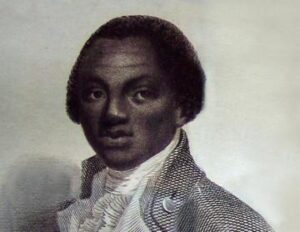
**Olaudah Equiano** was the campaign’s most important public figure. Born in what is now Nigeria around 1745, kidnapped and enslaved as a boy, he eventually purchased his own freedom and settled in London, where he became a leading figure in the Sons of Africa — an abolitionist group of African-born men. His *Interesting Narrative*, published in 1789, was a literary sensation and a political act: a first-person account of kidnapping, the Middle Passage, enslavement and liberation that made it impossible to discuss slavery in the abstract. He personally supervised eight editions of the book, correcting and improving it, and undertook extensive lecture tours of Britain. He was, by any measure, one of the most effective political communicators in British history.
**Ottobah Cugoano** was even more radical. Born in present-day Ghana, enslaved and transported to the Caribbean before being brought to England, Cugoano published *Thoughts and Sentiments on the Evil of Slavery* in 1787, the same year the Abolitionist Society was founded. His work was more demanding than Equiano’s: where Equiano navigated carefully around the sensibilities of white readers, Cugoano made direct demands. He called for immediate abolition — not the gradual approach that most white abolitionists favoured — and refused to accept the assumption that African people needed European guidance to be free.
**Ignatius Sancho**, **Phyllis Wheatley** and the wider network of the **Sons of Africa** contributed to a public discourse about enslaved people as articulate, educated, spiritually serious human beings — a discourse that directly challenged the dehumanising logic that the trade depended on.
The Haitian Revolution: The World Turned Upside Down
On 22 August 1791, enslaved people in the French colony of Saint-Domingue (modern Haiti) rose in revolt. Led initially by Toussaint L’Ouverture and eventually by Jean-Jacques Dessalines, the Haitian Revolution was the only successful slave revolt in history. After thirteen years of extraordinary violence — in which the revolutionaries defeated French, Spanish and British armies, including a major British expeditionary force sent to capture the colony — Haiti declared independence as the world’s first Black republic on 1 January 1804.
The Haitian Revolution’s effect on the abolitionist debate in Britain was profound and contradictory. For abolitionists, it demonstrated beyond question that enslaved people were fully human — capable of the most sophisticated political organisation, military strategy and statecraft. CLR James’s 1938 account *The Black Jacobins* remains the definitive history of the revolution.
For slaveholders and their supporters, Haiti was a nightmare — proof that slavery could not be maintained indefinitely and that the consequences of revolt could be catastrophic. Ironically, both lessons pointed in the same direction: the trade had to end, whether by reform or by revolution. Some historians argue that the Haitian Revolution accelerated abolition by persuading the British political establishment that a regulated end to the trade was preferable to the uncontrolled violence of revolt.
1806: The Turn of the Tide
By 1806, the political landscape had shifted decisively. Several factors converged:
- Wilberforce and his allies changed strategy, arguing in 1806 for a bill restricting the Foreign Slave Trade — the supply of enslaved Africans to foreign colonies — rather than seeking immediate total abolition. This was partly tactical: it separated the question of Britain’s domestic trade from the foreign trade, making it easier to build a parliamentary majority. The Foreign Slave Trade Act 1806 passed easily.
- The deaths of Pitt and Fox in 1806 reshuffled political alignments. The Grenville Ministry that took office was more sympathetic to abolition than its predecessors.
- The abolitionist campaign had, over twenty years, fundamentally shifted public opinion. The trade had become a moral embarrassment to the political class in a way it had not been in 1787.
On 10 February 1807, the House of Lords voted to abolish the slave trade. On 23 February, the House of Commons voted 283 to 16 in favour. The Slave Trade Act received Royal Assent on 25 March 1807.
After 1807: What Abolition Did Not Do
It is important to be clear about what the 1807 Act achieved and what it did not.
It abolished the British slave trade — the transportation of enslaved Africans on British ships. It did not abolish slavery itself. Enslaved people in British colonies continued to be held in bondage for a further twenty-seven years.
The trade continued illegally. British enforcement — through the Royal Navy’s West Africa Squadron — was sincere but imperfect. A significant illicit trade continued, particularly in the Cuban and Brazilian markets, for decades after 1807.
The political argument that abolishing the trade would improve conditions for enslaved people already in the colonies — by forcing planters to treat their workforce better — proved largely illusory. Conditions on Caribbean plantations remained brutal.
The Slavery Abolition Act of 1833, which finally freed enslaved people in British colonies, did so on terms that gave slave owners £20 million in compensation while giving the formerly enslaved people nothing. Its “apprenticeship” provisions, which required freed people to continue working for their former enslavers without pay for up to six years, were a travesty that was eventually abandoned in 1838 following sustained resistance.
These facts are not reasons to diminish the significance of abolition — it was a genuine moral and political achievement, won against powerful opposition after a long struggle. But they are reasons to situate it accurately: as a beginning rather than an end, as a partial rather than a complete reckoning with the consequences of two centuries of state-organised human trafficking.
Sources
- Williams, E. (1944): *Capitalism and Slavery*, University of North Carolina Press
- Drescher, S. (1977): *Econocide: British Slavery in the Era of Abolition*, University of Pittsburgh Press
- Hochschild, A. (2005): *Bury the Chains*, Macmillan
- James, C. L. R. (1938): *The Black Jacobins*, Secker & Warburg
- Equiano, O. (1789): *The Interesting Narrative of the Life of Olaudah Equiano*
- Cugoano, O. (1787): *Thoughts and Sentiments on the Evil of Slavery*
- Oldfield, J. R. (1995): *Popular Politics and British Anti-Slavery*, Manchester University Press
- Brown, C. L. (2006): *Moral Capital: Foundations of British Abolitionism*, University of North Carolina Press