Black People in England in the 1700s: Life, Freedom and Resistance
The history of Black people in England in the 1700s is far richer and more complex than is sometimes assumed. Black people were living, working and building relationships across England throughout the eighteenth century. They were servants and sailors, soldiers and musicians, writers and campaigners, craftspeople and business owners. Some were enslaved people brought to England against their will, while others were free individuals who established independent lives.
At The Black Presence in Britain, we believe Black British History is best understood by looking beyond famous names and major political events. The records of ordinary Black people reveal communities, families and working lives that formed part of English society long before the Victorian era or the arrival of HMT Empire Windrush.
By the late eighteenth century, historians estimate that around 15,000 Black people were living in England and Wales. London contained the largest Black population, but an African presence could also be found in British ports such as Liverpool, Bristol, Portsmouth and Southampton, as well as towns and villages elsewhere in the country.
Understanding these Black lives helps challenge the idea that Black immigration is a recent development. In reality, the Black presence in the British Isles stretches back much further, with evidence extending through Roman Britain, the Elizabethan period, Georgian Britain and beyond.
Who Were the Black People Living in Eighteenth-Century England?
There was no single universal Black experience.
Black people in England in the 1700s came from Africa, the Caribbean, North America and other parts of the Atlantic world. Their circumstances varied enormously. Some arrived as enslaved Africans accompanying slave owners returning from British colonies. Others came as sailors, soldiers, domestic servants, students or workers.
Britain’s growing empire and its involvement in the transatlantic slave trade increased movement between Africa, the West Indies, North America and British ports. British merchants, British traders and merchant vessels created trade routes which moved goods, wealth and people across the Atlantic.
This movement included forced migration on an enormous scale. Enslaved Africans were transported across the Atlantic and exploited throughout Britain’s colonial possessions.
However, it is important not to define every Black person living in England simply through slavery. There were also free Black workers, independent householders, sailors, shopkeepers, property owners, musicians and writers.
How Large Was the Black Population?
Establishing the precise Black population of eighteenth-century (1700s) England is difficult.
Britain’s first national census did not take place until 1801, and that census did not provide a reliable count based on ethnicity. Contemporary estimates also varied considerably.
Modern historical research suggests that around 15,000 Black people were living in England and Wales by the late eighteenth century, predominantly in London and major port cities.
The London populace therefore included a visible Black community. Contemporary estimates were sometimes considerably higher, which demonstrates why population figures from the period should be treated cautiously rather than repeated as established facts.
Black communities were not restricted to London. An African presence has been identified in Liverpool, Bristol, Portsmouth, Southampton and elsewhere.
The Transatlantic Slave Trade and Black Life in England
It is impossible to discuss Black people in England in the 1700s without examining the transatlantic slave trade.
Britain became one of the dominant European participants in Atlantic slavery. British merchants and vessels transported enslaved people, while wealth generated by plantations and associated industries flowed into English society.
The Royal African Company had played an important role in the earlier development of England’s slave trade, and during the eighteenth century British involvement expanded dramatically.
This affected Black people living in England directly.
Some wealthy families brought enslaved Africans or Black servants back from the Caribbean and North America. Black servants could be presented as symbols of wealth and status among the upper classes. Their status could range from paid employment to conditions that were effectively enslavement.
Advertisements for the sale, purchase and recapture of Black people provide disturbing evidence of how some Black men, women and children were treated.
At the same time, the precise legal position of slavery within England remained contested.
Black Servants and Domestic Life
Domestic servants formed a substantial proportion of the known Black population.
Black servants appeared in aristocratic households, paintings, newspaper advertisements, parish registers and other records. Some were paid workers. Others were enslaved or occupied an ambiguous position between employment and forced servitude.
A Black servant could sometimes become a fashionable status symbol for an affluent household. Young Black servants were occasionally dressed in elaborate clothing or even made to wear collars identifying the people who claimed ownership over them.
Yet individual experiences differed considerably.
Some Black servants obtained wages, property and greater independence. Others escaped employers or slave owners. Parish and church records also reveal baptisms, marriages and burials, providing glimpses of Black people developing relationships within local communities.
These sources matter because they reveal Black lives beyond the institutions of slavery.
Black Sailors, Soldiers and Servicemen
Black sailors were a particularly important part of eighteenth-century English society.
British ports connected England with the Atlantic world. Sailors of African and Caribbean heritage worked aboard Royal Navy ships and merchant vessels alongside white workers. Maritime employment could provide opportunities for mobility and wages, although racial prejudice and discrimination remained significant obstacles.
Black soldiers and Black servicemen were also involved in the British armed forces.
The American Revolutionary War was particularly significant. Thousands of enslaved African Americans supported the British after being offered freedom in return for military service or assistance. Black troops and Black Loyalists subsequently travelled throughout the British Atlantic world.
Some eventually reached Britain.
Former soldiers and sailors were among the people who became associated with London’s Black Poor during the 1780s. Poverty affected both Black and white people, but racial discrimination could make employment and economic security especially difficult for Black workers.
The later Napoleonic Wars also brought Black soldiers and prisoners to England. In 1796, more than 2,000 Black and mixed-race prisoners of war from the Caribbean arrived at Portsmouth and were held at Portchester Castle.
Their story demonstrates how war, empire and migration repeatedly brought African and Caribbean people into Georgian Britain.
Black Londoners and the Growth of Community
London was at the centre of Black society in eighteenth-century England.
Black Londoners lived in areas including Westminster and other districts where employment, lodging and social connections could be found. The Black population included servants, sailors, craftsmen, musicians, beggars, shopkeepers and writers.
Community networks were important.
Black people attended churches, married local women and men, had mixed-race children and formed friendships across racial and social boundaries. Churches and religious communities could provide both spiritual and practical support.
Evidence from the Somerset case also suggests that information travelled through Black communities. When important developments occurred, Black Londoners did not simply observe them. They discussed them, organised around them and acted upon them.
This is a crucial point in understanding Black British History. Black people were participants in Georgian society, not simply people to whom history happened.
Racism, Racial Attitudes and Discrimination
Black people nevertheless lived within a society profoundly influenced by slavery and ideas about racial difference.
Racial prejudice appeared in art, literature, advertisements and popular entertainment. Black people could be exoticised, caricatured or treated as property.
Racial discrimination could also restrict employment and social mobility.
However, racial attitudes in the eighteenth century should not simply be assumed to have operated identically to those of Victorian Britain or the twentieth century. Concepts of race changed over time and interacted with ideas about religion, social class, nationality and empire.
Understanding prejudice therefore requires historical context.
It is equally important to recognise agency. Black people resisted discrimination in everyday life by escaping forced servitude, seeking paid work, creating families, establishing businesses and challenging slave owners through the courts.
James Somerset and Lord Mansfield
One of the most significant legal cases involving a Black man in eighteenth-century England concerned James Somerset.
Somerset had been enslaved and brought to England by Charles Steuart. In 1771, Somerset left Steuart but was recaptured and held aboard a vessel intended to transport him to Jamaica.
His supporters sought a writ of habeas corpus.
The case reached Lord Mansfield, Chief Justice of the King’s Bench. In 1772, Mansfield ruled that Somerset could not legally be forcibly removed from England and transported overseas for sale.
The decision was extremely important, but its meaning is often oversimplified.
Lord Mansfield did not issue a general ruling abolishing slavery throughout England or the British Empire. Instead, the judgment addressed whether Somerset could lawfully be detained and forcibly transported out of England.
Nevertheless, the decision had enormous symbolic significance. Black communities followed the case closely, and reports described celebrations among Black Londoners following Somerset’s release.
Dido Elizabeth Belle
Lord Mansfield’s own household also provides one of the most famous examples of a Black woman living in Georgian Britain.
Dido Elizabeth Belle was born in 1761. She was the mixed-race daughter of Maria Bell, an enslaved African woman, and Royal Navy officer John Lindsay.
Belle was raised at Kenwood House by Lord Mansfield and his family.
Her position was unusual. She lived within an aristocratic household and received privileges unavailable to most Black women of the period, while her ancestry connected her directly with the world of slavery and empire.
Dido Elizabeth Belle therefore illustrates why there was no universal experience of being Black in eighteenth-century England.
Ignatius Sancho
Ignatius Sancho became one of the best-known Black Britons of the eighteenth century.
Born around 1729, Sancho eventually established an independent life in London. He became a composer, writer and shopkeeper and moved within influential literary and artistic circles.
Sancho is particularly significant because his surviving letters offer historians a Black voice from Georgian Britain.
He also qualified to vote as a male property owner, an exceptional position that demonstrates both his individual achievements and the complex intersections between property, class and political participation in eighteenth-century England.
Olaudah Equiano and Black Resistance

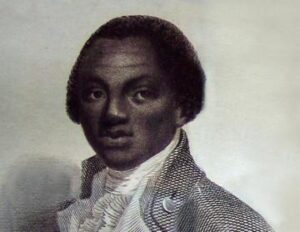
Olaudah Equiano became one of the most influential Black abolitionists of the eighteenth century.
After experiencing enslavement, Equiano purchased his freedom and eventually settled in Britain. His autobiography, published in 1789, became an important contribution to the abolitionist movement.
Equiano did not simply describe slavery. He became an active campaigner.
Alongside other African campaigners, including Ottobah Cugoano, he participated in organised resistance to the slave trade. The Sons of Africa became an important Black political organisation whose members wrote letters, lobbied politicians and contributed directly to the national debate.
Their activities demonstrate that abolition was not simply something achieved on behalf of enslaved Africans by white campaigners. Black people were central participants in the movement against slavery.
Phillis Wheatley and the Wider Atlantic World
Phillis Wheatley offers another perspective on the interconnected Black Atlantic world.
Born in West Africa and enslaved as a child in North America, Wheatley became an internationally recognised poet. She visited London in 1773, where her writing attracted considerable interest.
Her presence illustrates how Black intellectual and cultural life connected England, Africa, the Caribbean and North America.
Black British History cannot therefore be understood solely within England’s geographical borders. Georgian Britain was part of an Atlantic system in which people, ideas, literature, commerce and political movements circulated internationally.
The Black Poor and Sierra Leone
By the 1780s, poverty among parts of London’s Black population had become increasingly visible.
The term “Black Poor” was used for an economically disadvantaged group that included former sailors, soldiers and servants. Some had served the British during the American Revolutionary War.
A controversial scheme was developed to establish a settlement in Sierra Leone in West Africa.
Several hundred Black people departed Britain for Sierra Leone in 1787. The settlement faced severe difficulties, and the history of the project reveals the complicated relationship between philanthropy, empire, race and attempts to address poverty.
It also demonstrates that Black immigration and emigration were already part of debates about English society long before modern immigration control.
Black People and the Abolition Movement
During the closing decades of the eighteenth century, opposition to the slave trade became a major political movement.
Black writers and activists supplied something especially powerful: testimony from people who had personally experienced enslavement.
Olaudah Equiano and Ottobah Cugoano were among those who publicly challenged the slave system. Black abolitionists worked alongside wider networks of campaigners, religious groups and political activists.
The campaign continued into the nineteenth century.
Parliament abolished the British slave trade in 1807. The Slavery Abolition Act followed in 1833 and came into effect in 1834 across most of the British Empire, although systems of coerced “apprenticeship” continued for several more years.
These later developments should not be projected backwards onto the 1700s. The eighteenth century was instead the period in which Black resistance, legal challenges and organised abolition increasingly exposed the contradictions of a society that discussed liberty while deriving enormous wealth from slavery.
A Black Presence Long Before the 1700s
Black history in Britain did not begin in Georgian Britain.
Evidence for people of African ancestry reaches much further back. Research into Roman Britain, including individuals sometimes discussed collectively as the Four Roman Londoners and the Ivory Bangle Lady from Roman York, demonstrates connections between Britain, Africa and the wider Roman Empire.
The Roman army recruited across an enormous geographical area, including North African provinces.
Centuries later, records identify African people in Tudor and Elizabethan England. John Blanke served as a trumpeter at the royal court during the reigns of Henry VII and Henry VIII. Mary Fillis lived in Elizabethan London. Other records provide evidence of African people working, marrying and participating in local communities.
This longer chronology matters.
It places Black people in England in the 1700s within a much broader Black British History rather than treating eighteenth-century Black immigration as the beginning of Britain’s African presence.
Frequently Asked Questions About Black People in England in the 1700s
How many Black people lived in England during the 1700s?
There is no exact figure because reliable ethnicity data were not collected through a national census. Modern estimates suggest around 15,000 Black people lived in England and Wales by the late eighteenth century, with the largest population in London and smaller communities in major ports and elsewhere.
Were there Black slaves in England in the 1700s?
Yes. Enslaved people were brought to England by slave owners, particularly from the Caribbean and North America. Their legal position within England was complicated and contested. The 1772 Somerset case established that James Somerset could not legally be forcibly transported out of England for sale into slavery, but it did not abolish slavery throughout the British Empire.
What jobs did Black people have in eighteenth-century England?
Black people worked as domestic servants, sailors, soldiers, musicians, craftsmen, shopkeepers and other workers. Some established independent businesses. Ignatius Sancho became a shopkeeper, while George Africanus later established a successful employment agency in Nottingham.
Were there Black soldiers in eighteenth-century Britain?
Yes. Black soldiers and sailors served within Britain’s military and maritime world. The American Revolutionary War also resulted in thousands of Black Loyalists supporting Britain, while the Royal Navy and merchant fleets employed Black sailors throughout the Atlantic world.
Where did most Black people in England live?
London had the largest known Black population. Black communities and individuals were also found in Liverpool, Bristol, Portsmouth, Southampton and other British ports, as well as towns, villages and rural households across England.
Did the Somerset case abolish slavery in England?
Not exactly. Lord Mansfield’s 1772 judgment ruled that James Somerset could not be forcibly removed from England and transported abroad for sale. The ruling was widely interpreted as a major victory against slavery and became important to the abolition movement, but Mansfield deliberately avoided issuing a broad judgment abolishing slavery itself.
What evidence proves there was an African presence in eighteenth-century England?
Evidence comes from parish registers, baptism and marriage records, court proceedings, wills, newspapers, paintings, military records, shipping documents, personal letters and autobiographies. Sources held by institutions such as The National Archives allow historians to reconstruct individual Black lives that were previously overlooked.
Why is Black British History before Windrush important?
The Windrush generation is a vital part of modern Black British History, but Black presence in Britain stretches back many centuries. Exploring Roman Britain, Tudor England, the Elizabethan period and Georgian Britain reveals that people of African heritage have been part of British society for far longer than is sometimes assumed.
Recovering Black Lives From the Historical Record
The history of Black people in England in the 1700s is not simply a history of slavery.
It is a history of slavery, certainly, but also one of employment, migration, military service, family, religion, business, literature, community, resistance and independence.
Black Londoners and Black Britons participated in English society while confronting racial prejudice and discrimination. Enslaved Africans challenged slave owners. Black sailors travelled the Atlantic. Black soldiers served in the British armed forces. Writers such as Ignatius Sancho, Olaudah Equiano and Ottobah Cugoano entered public debate. Women such as Dido Elizabeth Belle occupied positions that complicate simple assumptions about race and social status in Georgian Britain.
The Black presence in eighteenth-century England was therefore not peripheral to British history. It was intertwined with the country’s empire, economy, military, ports, politics and changing ideas about freedom.
At The Black Presence in Britain, our work explores these overlooked Black lives and places them back into the wider story of Britain. By examining original records, individual biographies and the historical context surrounding Black communities, we can build a fuller picture of a past that was considerably more diverse than conventional accounts once suggested.
Discover More Black British History
Explore more stories, historical research and overlooked Black lives with The Black Presence in Britain. If you have a research enquiry, historical story or information that could contribute to our work, please visit our Contact page and get in touch.