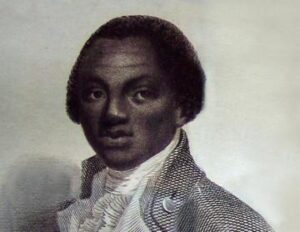
Escaping slavery in America, Frederick Douglass found in Britain a powerful network of abolitionist support and the funds that would legally secure his liberty.
In August 1845, a young man who had escaped slavery in Maryland stepped off a ship in Liverpool. Frederick Douglass (c.1818–1895) was already becoming famous in America for his powerful oratory and his recently published autobiography. But he was also a fugitive, at constant risk of being captured and returned to his ‘owners.’ He came to Britain to seek safety and to build international support for the abolitionist cause.
A Warm Reception
Douglass spent nearly two years in Britain and Ireland, delivering hundreds of lectures to packed halls in cities from Cork and Dublin to London, Manchester, and Glasgow. He was shocked by the reception he received. In America, he had been used to being barred from hotels, restaurants, and public transport. In Britain, he found himself invited to the homes of the elite and treated with a respect he had never known.
“The truth is,” he wrote to a friend, “the people here are better than they are at home… I find myself not only a man, but a brother.” This experience of freedom in Britain was transformative for Douglass, deepening his commitment to universal human rights and providing him with a global perspective on the struggle against slavery.
The British Abolitionist Network
Douglass’s tour was organised by a sophisticated network of British abolitionists, many of them women and members of the Quaker community. These activists provided the funding, the venues, and the publicity that made his tour a success.
Notable supporters included **Ellen Richardson** and her sister-in-law **Anna Richardson** of Newcastle. It was these two women who took the extraordinary step of raising £150 (a significant sum at the time) to purchase Douglass’s legal freedom from his American ‘owner,’ Thomas Auld. In December 1846, the man who had arrived in Britain as a fugitive became a legally free man.
Impact on British Thought
Douglass did more than just tell his story; he challenged British audiences to see the connection between their own wealth and the slave system of the American South. He spoke about the ‘blood-stained’ cotton that fed the mills of Lancashire and the complicity of the British church in maintaining ties with pro-slavery denominations in the US.
His presence in Britain helped to revitalise the British anti-slavery movement, which had lost some of its momentum after the abolition of slavery in the British colonies in 1833. He reminded his audiences that the struggle for freedom was global and that Britain had a moral responsibility to lead the way.
Returning Home a Free Man
When Douglass returned to the United States in 1847, he was a changed man. He used the money he had raised in Britain to establish his own newspaper, *The North Star*, and he became a leading figure in the American Civil War and the subsequent struggle for civil rights.
The time he spent in Britain remained a touchstone for him throughout his life. He returned to the UK in 1859 and 1886, maintaining his lifelong friendships with British abolitionists. Today, plaques in London, Edinburgh, and Newcastle commemorate his visits, marking the legacy of the man who found his freedom on British soil.
Key Sources and Further Reading
- Douglass, F. (1845): *Narrative of the Life of Frederick Douglass, an American Slave*.
- Rice, A. and Crawford, M. (1999): *Liberating Sojourn: Frederick Douglass and Transatlantic Reform*, University of Georgia Press.
- Sweeney, F. (2007): *Frederick Douglass and the Atlantic World*, Liverpool University Press.
- Fenton, L. (2014): *Frederick Douglass in Ireland*, Collins Press.