The Notting Hill Carnival — now Europe’s largest street festival — began not in the streets but in a town hall, organised by a Trinidadian communist deported from America who used Caribbean joy as a weapon against racist violence.
On the night of 30 January 1959, a Caribbean Carnival was held in St Pancras Town Hall in north London. It was not the first celebration of its kind, and it would not be the last. But it was the one that mattered — the one that set in motion the chain of events that would eventually produce the Notting Hill Carnival, now the largest street festival in Europe and the second largest carnival in the world after Rio de Janeiro.
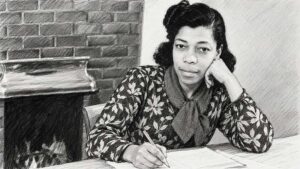
The woman who organised it was **Claudia Jones**. And her story is one of the most remarkable in the history of Black Britain.
Claudia Jones: Communist, Feminist, Exile
Claudia Jones was born in Port of Spain, Trinidad, in 1915. Her family emigrated to the United States when she was nine years old, settling in Harlem, New York. She grew up in poverty, contracted tuberculosis that would damage her health for the rest of her life, and became politically active in her teens, joining the Communist Party of the USA and rising to become one of its most prominent Black women.
Her political work — she wrote extensively on the “triple oppression” of Black women as victims of racism, sexism and capitalism, anticipating by decades what would later be called intersectionality — made her a target of the US government during the McCarthy era. She was arrested four times under the Smith Act, imprisoned, and in 1955, following her final conviction, was deported from the United States.
The British government accepted her, somewhat reluctantly. She arrived in London in December 1955, unwell, penniless and exiled from the country where she had spent most of her life. She was thirty-nine years old.
The Notting Hill Race Riots
In August and September 1958, white racist mobs attacked Caribbean homes and residents in Notting Hill in west London. The riots lasted several days and nights. Caribbean men and women defended their homes and their communities. The police were slow to protect them and quick to arrest those who fought back. The riots were a watershed moment — evidence that the racism Caribbean settlers faced was not merely the hostility of individual landlords and employers but a systematic, violent threat.
Claudia Jones understood that the Caribbean community needed to respond to the riots in a way that demonstrated its vitality and refused to be defined by the violence it had suffered. She had already founded the *West Indian Gazette and Afro-Asian Caribbean News* — Britain’s first major Black newspaper — in 1958, and she used it as both a news outlet and an organising tool.
Her response to the riots was the Caribbean Carnival.
The Indoor Carnivals
The first carnival, held in January 1959 at St Pancras Town Hall, was broadcast on the BBC. It featured Caribbean music, dance, fashion and food. Jones called it “A people’s art form.” It was explicitly political — a demonstration that Caribbean culture was worthy of celebration and that Caribbean people refused to be made invisible by racism.
Jones organised the indoor carnival annually until 1964. The events rotated between St Pancras Town Hall, Seymour Hall in the West End and other London venues. They were joyous occasions — mas costumes, calypso music, the Miss Carnival Queen contest — but they were also politically serious. Jones used them to raise money for the *West Indian Gazette*, to build networks among Caribbean communities in Britain, and to make an argument about culture and dignity.
**Claudia Jones died on 24 December 1964**, at the age of forty-nine, of heart failure exacerbated by the tuberculosis she had carried since childhood. She had given the last decade of her life, in exile, to building Caribbean community life in Britain. She was buried in Highgate Cemetery, next to Karl Marx.
Into the Streets
After Jones’s death, the indoor carnival tradition continued under different organisers. In 1966, **Rhaune Laslett** — a community activist working in Notting Hill — organised a neighbourhood fair in the streets of the area, partly drawing on the indoor carnival tradition. She invited a Trinidadian steelband to play. The event drew a crowd. People began to dance. Something had shifted.
The outdoor Carnival grew slowly through the late 1960s. **Leslie Palmer**, a Trinidadian who came to London in the 1960s, took over the organisation in 1973 and transformed it: he introduced the mas bands and the parade format that would become the template for modern Carnival, and he worked to bring the full range of Trinidadian Carnival culture — the costumes, the masquerade, the competitive spirit — to London streets.
By the mid-1970s, Carnival had become a genuine mass event, drawing hundreds of thousands of people over the August bank holiday weekend. It had also become a site of political tension. Young Black Britons used Carnival to express their frustration with racist policing and their solidarity with each other. The **1976 Carnival** ended in clashes between police and young Black people — clashes that reflected the wider tensions of the period and that would recur at Brixton in 1981 and Tottenham in 1985.
What Carnival Became
Notting Hill Carnival today is extraordinary: two days of music, colour, food, mas and dance that draw over a million people to west London. Its sound systems play everything from soca to grime, from reggae to dancehall. Its mas bands create costumes of astonishing beauty. Its food stalls sell jerk chicken, saltfish, roti, curried goat and ackee to crowds from every part of London and the world.
It is a long way from the town hall in St Pancras where Claudia Jones organised her first indoor carnival in response to racist violence. But the thread runs unbroken. Carnival was created as an act of resistance — a refusal to be defeated, a demonstration that Caribbean culture was alive and worthy of celebration and that it belonged in Britain.
That is still what it is. Claudia Jones, buried in Highgate Cemetery, would recognise it.
Sources
- Sherwood, M. (1999): *Claudia Jones: A Life in Exile*, Lawrence and Wishart — the definitive biography
- Alibhai-Brown, Y. (2000): *Who Do We Think We Are?*, Allen Lane
- Olusoga, D. (2016): *Black and British: A Forgotten History*, Macmillan
- Fryer, P. (1984): *Staying Power: The History of Black People in Britain*, Pluto Press
- The Notting Hill Carnival archives: various oral history interviews available through the Black Cultural Archives, Brixton
- Phillips, M. and Phillips, T. (1998): *Windrush: The Irresistible Rise of Multi-Racial Britain*, HarperCollins