The Royal African Company was chartered by Charles II in 1672, with the Duke of York as its governor. It held a monopoly on Britain’s slave trade for a quarter century, branding enslaved people with its initials — and its shareholders included the English royal family.
When we speak of the transatlantic slave trade, we sometimes speak as though it were the work of pirates, rogue merchants and lawless frontier capitalism. In fact, for the first crucial decades of Britain’s involvement in the trade, it was a royal enterprise — backed by the Crown, managed by the aristocracy, and given the full legal protection of the state.
The Royal African Company (RAC) was chartered by King Charles II in 1672. Its founding governor was James, Duke of York — the king’s brother and heir to the throne, who would become King James II in 1685. Its shareholders included members of the royal family, leading aristocrats and prominent City of London merchants. It was, in every meaningful sense, the British state’s instrument for the organisation and conduct of the slave trade.
The Monopoly
The Royal African Company’s charter gave it a monopoly over English trade with West Africa — including, explicitly, the trade in enslaved Africans. No other English merchant could legally participate in the Atlantic slave trade without the company’s permission. The RAC was responsible for building and garrisoning the chain of forts and trading posts on the West African coast — most importantly Cape Coast Castle in what is now Ghana, which served as the primary holding station through which enslaved Africans passed before being loaded onto ships for the Middle Passage.
Cape Coast Castle is one of the most significant and disturbing sites in the history of the Atlantic world. Built originally by the Swedes and then the Danes before being taken over by the English in 1664, it is a large whitewashed fortress overlooking the Atlantic. Beneath its gracious colonnade and officers’ quarters lie the dungeons — dark, low-ceilinged holding cells where enslaved Africans were confined in appalling conditions for weeks or months while awaiting the arrival of ships. A door in the castle’s seaward wall was known as the “Door of No Return.” Those who passed through it onto the waiting ships were, in most cases, leaving Africa forever.
The Brand
The Royal African Company’s mark — first “DY” for the Duke of York, then “RAC” — was used in a way that reveals everything about the trade’s conception of its human cargo. The letters were branded, with a hot iron, onto the chests of enslaved Africans before they were loaded onto ships. The same initials were burned into barrels of goods and bolts of cloth. Human beings and trade goods received the same mark of ownership.
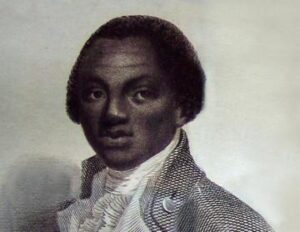
This branding was not universally practised — some merchants dispensed with it — but the RAC’s use of it was systematic. When Olaudah Equiano described seeing branded men and women, he was describing the Royal African Company’s property-marking system applied to people.
The Volume of the Trade
Between 1672 and the loss of its monopoly in 1698, the Royal African Company transported approximately 100,000 enslaved Africans across the Atlantic. This figure has been established by careful analysis of the company’s surviving records, which are extraordinarily complete — the RAC kept meticulous accounts of its trade, including the numbers of enslaved people loaded, those who died during the crossing, and those sold at the destination.
The records are a bureaucratic record of mass death. On a typical RAC voyage, between ten and twenty per cent of those loaded in Africa died before reaching the Americas. On the worst voyages, the mortality rate was much higher. The Company’s response to this was actuarial rather than moral: it adjusted its business model to account for expected mortality rates, loading ships with more enslaved people than they could safely carry on the calculation that even with significant deaths, the cargo that survived would be profitable.
The End of the Monopoly
The Royal African Company’s monopoly was broken in 1698, when Parliament — responding to pressure from independent merchants in Bristol and London who wanted access to the profitable trade — passed legislation opening the Atlantic slave trade to all English merchants on payment of a ten per cent duty to the RAC for the upkeep of its African forts.
The effect was immediate and dramatic. The trade expanded rapidly as dozens, then hundreds, of merchant ships entered the previously restricted market. Bristol, which had been largely locked out of the trade during the monopoly years, quickly became one of its leading centres. Liverpool, which barely participated before 1698, grew over the following century to become the world’s largest slaving port.
The RAC itself declined following the loss of its monopoly. It continued to operate its African forts and to conduct a diminishing trade until it was finally wound up in 1752. Its forts were transferred to a successor body, the Company of Merchants Trading to Africa, which maintained them until the abolition of the trade in 1807.
The Royal Connection
The involvement of the English royal family in the slave trade is a fact that has not always been foregrounded in public discussions of this history. James, Duke of York — who as King James II became one of the most controversial monarchs in English history, deposed in the Glorious Revolution of 1688 — was the RAC’s governor and one of its largest shareholders. King Charles II was himself a shareholder. Other investors included the philosopher John Locke (whose political philosophy famously asserted natural human liberty) and the diarist Samuel Pepys.
The historian William Pettigrew, in his major study *Freedom’s Debt: The Royal African Company and the Politics of the Atlantic Slave Trade* (2013, University of North Carolina Press), argues that the history of the RAC is inseparable from the history of British constitutional politics: the struggle between the Company’s monopoly and the independent merchants who wanted access to the trade was part of the broader political struggle between Crown prerogative and parliamentary power that defined the Restoration period.
Legacy
The Royal African Company is one of the clearest demonstrations that the British slave trade was not a marginal or unofficial activity — it was a project of the British state, conducted under royal charter, managed by the king’s brother, and protected by law. The wealth it generated flowed into the mainstream of British commercial and social life. Its successor institutions — the trading companies, insurance markets and banks that grew from its networks — helped construct the financial infrastructure of modern Britain.
Understanding the Royal African Company is essential to understanding why the British state’s later abolition of the trade was insufficient: the trade’s profits had already been integrated into British wealth over the course of a century and a half, and no provision was made for the return of that wealth to those who had been its source.
Sources
- Pettigrew, W. A. (2013): *Freedom’s Debt: The Royal African Company and the Politics of the Atlantic Slave Trade, 1672–1752*, University of North Carolina Press
- Davies, K. G. (1957): *The Royal African Company*, Longmans
- Thomas, H. (1997): *The Slave Trade*, Simon & Schuster
- Olusoga, D. (2016): *Black and British: A Forgotten History*, Macmillan
- Trans-Atlantic Slave Trade Database: slavevoyages.org (Emory University)
- National Archives (Kew): Royal African Company records, T70 series